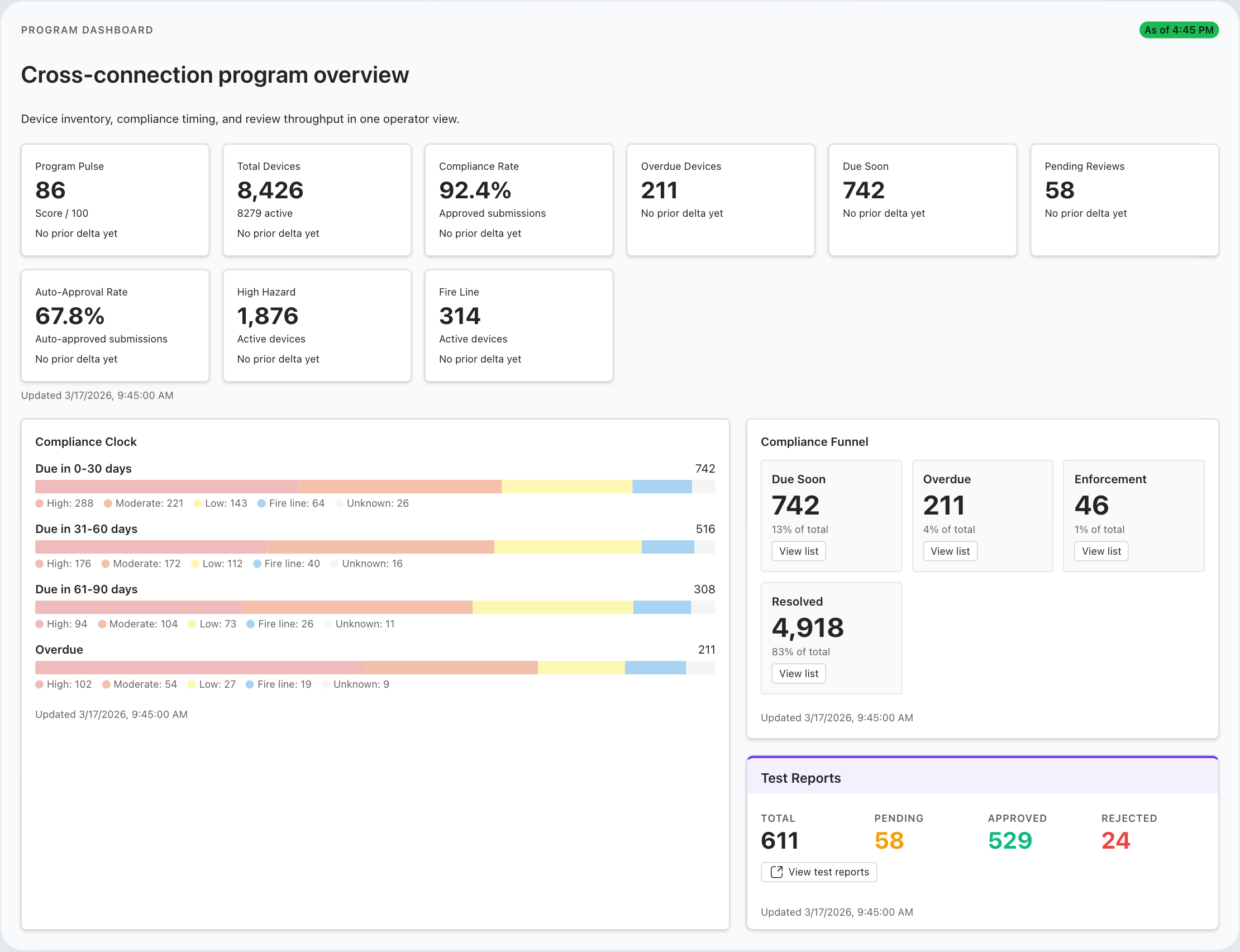
Managing a backflow prevention program means juggling a surprising number of moving parts. Beyond simply knowing which devices exist on your system, utilities are responsible for tracking testing schedules, verifying tester credentials, managing test kit calibrations, recording outcomes, and following up on failures while staying compliant with state and local regulations.
Why Annual Testing Exists
Backflow prevention assemblies are mechanical devices. Springs, seals, check valves, and diaphragms degrade over time. A device that passed inspection last year may not be performing adequately today, and annual testing is the most reliable way to confirm that each assembly is still doing its job.
Annual testing is also a legal requirement in most U.S. jurisdictions. States typically delegate enforcement authority to local water utilities, which means utilities need documented compliance records and a current view of which devices are in or out of compliance.
1. Device Inventory
Every backflow compliance program starts with a complete and accurate inventory of assemblies under the utility's jurisdiction. You cannot schedule tests, send notices, or track outcomes for devices you do not know about.
Your inventory should capture, at minimum:
- Device serial number and make or model
- Assembly type, such as RP, DCVA, or PVB
- Installation location and service address
- Hazard classification
- Installation date and initial test record
- Property owner or responsible party contact information
Maintaining an up-to-date inventory is an ongoing challenge. New installations are added, devices are replaced or relocated, and properties change ownership. Programs that rely on static records quickly find their data drifting from reality.
2. Testing Due Dates
For most assemblies, testing is required annually, either within twelve months of the previous passing test or from a fixed calendar date, depending on local rules. Some utilities use anniversary dates while others assign a fixed month by service address or device type.
Testing is also required after repair or replacement. An assembly that has been serviced must be retested before it returns to service, and high-hazard facilities may be subject to more frequent testing windows. The key requirement is simple: utilities must know the due date for every device, not just whether it has been tested at some point in the past.
3. Certified Tester Credentials
Only state-certified backflow assembly testers may perform compliance tests. What counts as a valid certification varies by state, and some jurisdictions now require certifying bodies to meet additional accreditation standards. Utilities are responsible for verifying that any tester submitting reports holds a current and valid credential.
Each tester record should include:
- Full name and contact information
- Certification number and issuing body
- Certification expiration date
- Employer or company affiliation, where applicable
Accepting reports from uncertified or expired testers exposes the utility to compliance risk. Best practice is to maintain an approved tester list and reject submissions that do not match a credentialed tester on file.
4. Test Kit Calibration Records
A certified tester is only as reliable as their equipment. Backflow test kits must be calibrated annually by an approved calibration center. A test performed with an out-of-calibration gauge is not considered valid.
Utilities should require proof of current gauge calibration before accepting test reports, and that proof must be managed continuously rather than as a one-time check.
5. Test Results and Pass-Fail Outcomes
When a test is completed, the tester submits a report documenting the test date, the device, the procedure used, and the measured values that determine whether the device passes or fails. Utilities are responsible for reviewing, recording, and retaining those reports.
For devices that fail, the timeline for follow-up matters. A failed device is not a closed record. It is an open compliance item that requires repair and a passing retest within the utility's required window.
6. Non-Compliance and Enforcement Tracking
When a test is overdue, a device fails, or a required repair is not completed on time, the utility must escalate. Many programs follow a structured enforcement process that starts with an initial notice, continues with a thirty-day follow-up, and ends with a warning of service interruption if compliance is not achieved.
Utilities need to track not just the compliance status of each device, but also the notices sent, the dates they were sent, and any response received. That documentation supports internal management and demonstrates due diligence to regulators.
7. Annual Reporting to State Regulators
Many states require utilities to submit annual reports covering total devices, tested devices, pass rates, failures, resolution status, and overall compliance performance. Producing those reports accurately requires clean records throughout the year rather than a scramble at reporting time.
Pulling It All Together
Managing these obligations manually through spreadsheets, paper files, or disconnected systems may work for very small programs, but it becomes increasingly difficult as the device inventory grows. Administrative burden rises, errors compound, and staff time shifts away from higher-value compliance work.
Purpose-built backflow management software is designed to centralize these responsibilities by maintaining the inventory, tracking due dates, validating tester credentials and calibration status, processing test reports, managing follow-up on failures, and generating compliance reports from the same system.