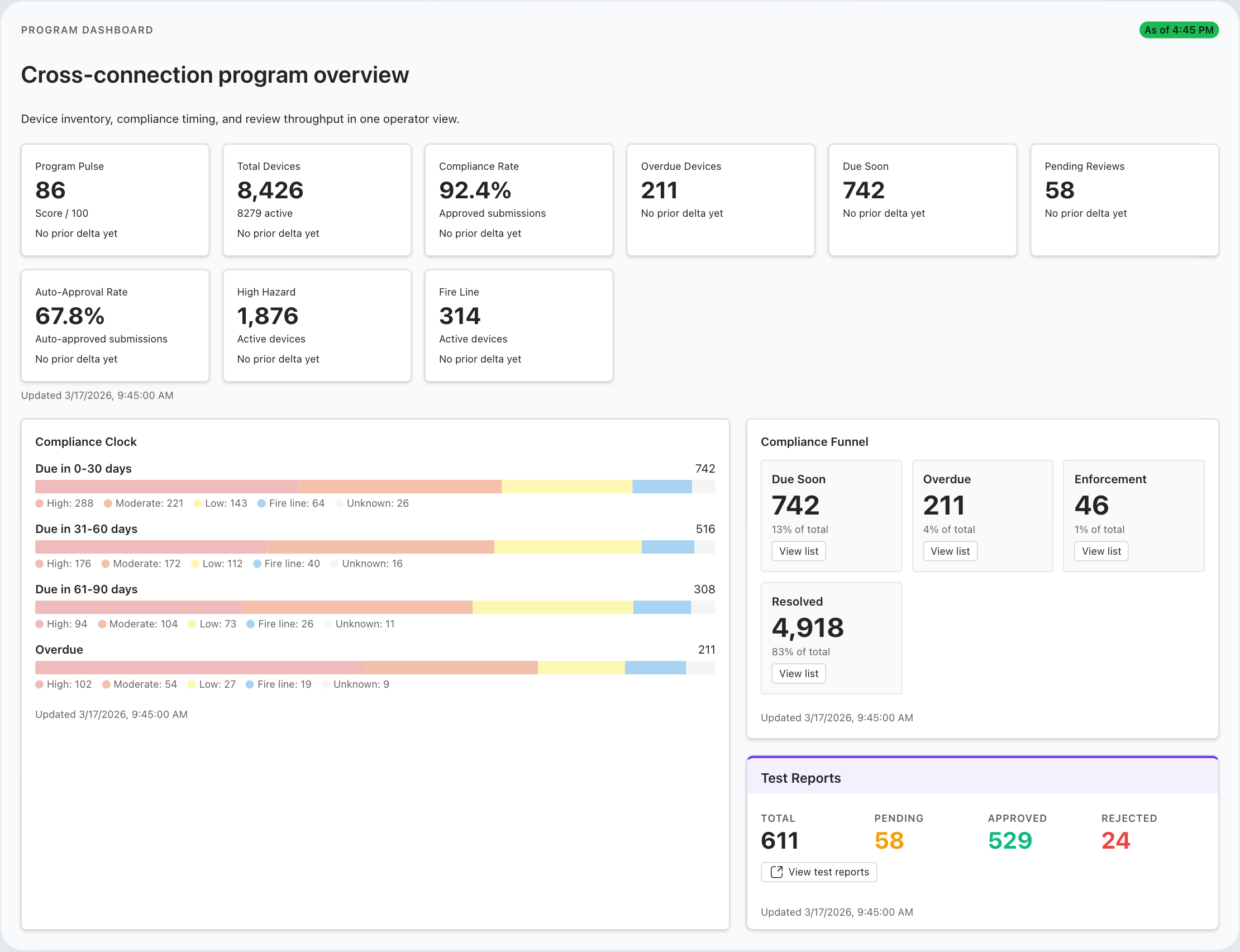
Most water utilities do not make a conscious decision to stay on outdated systems. A spreadsheet that worked when the program had a few hundred devices starts to strain at a larger scale. A reporting process that once took a day starts taking a week. By the time the problem is obvious, the program has often been operating below its potential for years.
Sign 1: You Are Regularly Missing Testing Deadlines
If overdue devices are only being discovered after the deadline has passed, that is usually a systems problem rather than a staffing problem. Manual workflows depend on someone proactively checking due dates on a regular basis, and that review is easy to miss when staff are stretched.
A purpose-built system tracks due dates automatically and sends reminders before deadlines arrive, which helps the program stay ahead of compliance instead of reacting after the fact.
Sign 2: You Cannot Easily Answer Basic Program Questions
Can you answer these questions without opening multiple files: What is the current compliance rate? How many devices are overdue? How many failed devices are still awaiting a passing retest? Which testers have credentials expiring soon?
If answering those questions takes manual filtering, row counting, or a follow-up with another staff member, the program lacks the real-time visibility needed for strong management.
Sign 3: Tester Credential Verification Is Inconsistent
Every test report should come from a tester with a current certification and an in-calibration test kit. In manual workflows, that verification often requires cross-checking separate records, which makes it time-consuming and easy to perform inconsistently.
That inconsistency creates compliance risk, especially in jurisdictions that explicitly reject reports from testers whose credentials are not current in the utility's records.
Sign 4: Annual Reporting Takes Days Instead of Minutes
If annual reporting still means reconciling multiple spreadsheets, manually counting records, and formatting summaries for regulators or leadership, your data infrastructure is working against the team.
The cost is not just staff time. Manual report compilation also increases the risk of errors that are awkward and time-consuming to explain later.
Sign 5: Staff Spend More Time on Administration Than Compliance
When staff are spending substantial time on data entry, chasing test results, manually sending notices, and reconciling records, the administrative layer is crowding out the work that actually improves compliance and protects the water supply.
In a healthier operating model, that administrative work is automated as much as possible so staff can focus on compliance management, communication, and enforcement.
What to Do Next
If your program matches more than one of these signs, it is worth taking a structured look at what a modern backflow management platform could offer. That evaluation should consider device volume, current data quality, reporting requirements, and how a new platform would fit your broader utility systems.
The encouraging news is that purpose-built platforms are usually faster to implement than utilities expect, and the administrative savings tend to appear quickly once the system is in place.